About Chris Allsman
Please see my resume here for a complete list of my experience. Below I elaborate on some recent themes in my work; I have other projects listed here, but at the moment they are mostly an archive of my undergraduate work.
Security
Since September 2020, I have worked on OpenText's Static Application Security Testing (SAST) product as a software engineer. Primarily, I develop components utilizing compiler construction techniques to generate intermediate representations for languages and frameworks including JavaScript/TypeScript, Vue, Solidity, and PL/SQL.
Increasingly, I have done work with algorithms for dataflow analysis & abstract interpretation. Most recently, I've been working with security researchers on an API for defining security rules which allows for language-specific semantics to be injected into the shared analysis pipeline.
Privacy
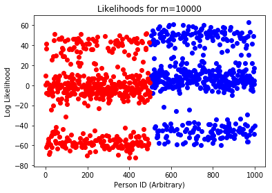
My thesis research at Columbia University under Dr. Gamze Gürsoy was titled "Evaluating Privacy-Preserving GWAS Summary Statistic Release". The work (in preparation for submission) explores the utility and protection offered by differential privacy for genetic data science tasks.
Building on seminal research on membership inference attacks in the context of genome-wide association studies (GWAS), we present tighter bounds on the residual risk of releasing statistics, making relevant distributional assumptions and presenting our results as a more interpretable power-false positive rate tradeoff.
Justice-Oriented Research Practices
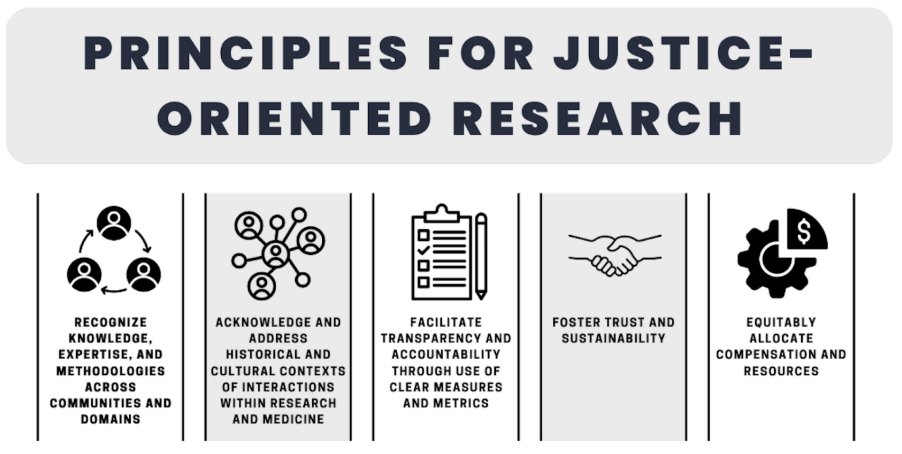
With the Justice Informatics Collaborative (JIC) - a student-led group at Columbia - I worked on a project engaging biomedical informatics practitioners to identify gaps, priorities, and opportunities for conducting justice-oriented research. This involved running a workshop and conducting a qualitative (thematic) analysis to synthesize principles applicable across biomedical informatics disciplines.
This work was published in JAMIA under the title Contextualizing key principles to promote a justice-oriented informatics research agenda: proceedings and reflections from an American Medical Informatics Association workshop and was presented at the 2023 and 2024 AMIA Annual Symposia.
Teaching
I view education as a way to empower practitioners to conduct work that embodies their values and as a mechanism by which students can begin to envision themselves as practitioners. From 2017-2019, I was involved with undergraduate education at UC Berkeley and volunteered as a teacher for the 2021-2022 school year through the Microsoft TEALS Program.
Though my experience has primarily been in introductory (CS0/CS1) courses, I am interested in opportunities to explore privacy/security and justice-centered computing education at any level.
Some accomplishments:
- Taught CS 61A at UC Berkeley for 6 semesters, including 2 semesters as a Head TA and a summer as a co-instructor.
- Recognized as an Outstanding GSI and for Outstanding Undergraduate Teaching and Leadership.
- Developed and piloted a new project, presented at SIGSCE 2020 and still used in the course as of 2026.
- Served with Computer Science Mentors for 6 semesters, including as a course coordinator and Internal Vice President. The organization provided small-group, personalized teaching for ~1,000 students each semester. I'm especially proud that I was able to mentor dozens of very talented junior teachers (and maintained the infrastructure to train hundreds more).